Full-Arch All-on-4 Dental Implant Prices in Europe: 2026 Cost Breakdown
In 2026, the average all on 4 dental implants cost Europe ranges from €5,800 to €18,500 per arch, depending on clinic jurisdiction and prosthetic material. Central European surgical centres average €6,400, whereas Swiss, British, and Nordic clinics charge €13,500 to €18,500. The breakdown below itemises fixture brands, laboratory fees, and surgical exclusions.
2026 European All-on-4 Price Matrix by Region and Prosthetic Tier
Full-arch implant rehabilitation fees vary by up to 190% across the European Economic Area (EEA) and the United Kingdom due to clinical overhead, dental technician labour rates, and value-added tax rules. While medical procedures remain VAT-exempt in most EU member states under Council Directive 2006/112/EC, laboratory fabrications and private hospital facility fees differ sharply by country.
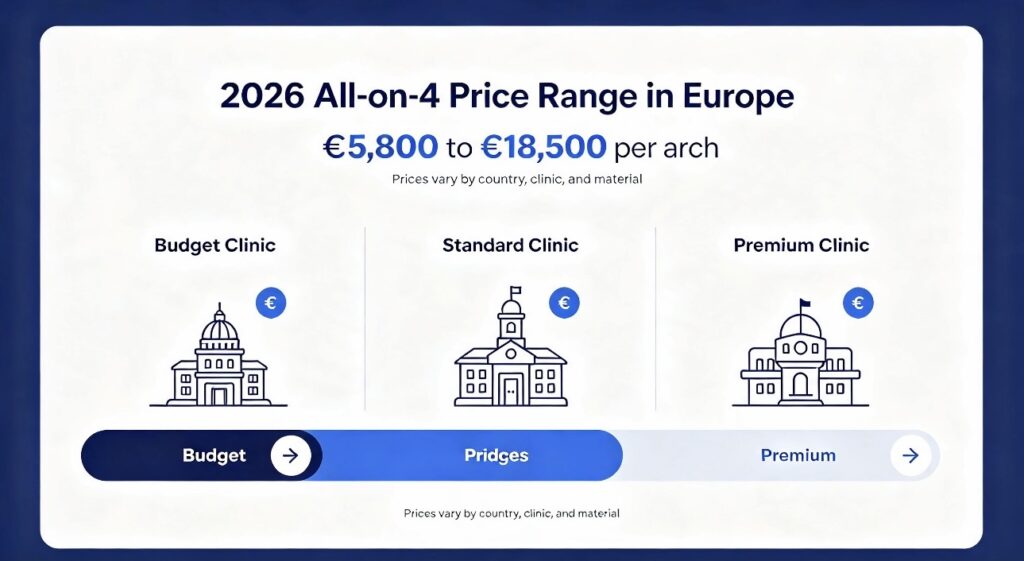
Clinics structure quotes around two final bridge tiers: reinforced acrylic hybrid prostheses on a milled titanium bar, or computer-milled monolithic zirconia arches. Reviewing regional benchmarks prevents patients from overpaying for identical EU Medical Device Regulation (MDR) Class IIb hardware.
| European Region / Country Tier | Acrylic-Titanium Hybrid Arch (€) | Monolithic Zirconia Final Arch (€) | Standard Warranty Coverage | Typical Surgical Timeline |
| Switzerland (Zurich, Geneva) | €14,200–€17,500 | €16,800–€21,000 | 10 years fixtures / 5 years bridge | 2 visits over 4–6 months |
| UK, Ireland & Nordics (SE, NO, DK) | €11,500–€14,800 | €13,900–€18,500 | 10 years fixtures / 5 years bridge | 2 visits over 4–6 months |
| Germany, Netherlands & Belgium | €9,800–€12,600 | €12,200–€15,900 | 10 years fixtures / 5 years bridge | 2 visits over 3–5 months |
| Spain & Portugal (Madrid, Lisbon) | €7,200–€9,400 | €8,900–€11,800 | 10 years fixtures / 3–5 years bridge | 2 visits over 3–5 months |
| Hungary, Poland & Croatia | €5,800–€7,400 | €7,100–€9,200 | Lifetime fixture / 5 years bridge | 2 visits over 3–4 months |
Component-by-Component Cost Breakdown of a Full-Arch Rehabilitation
An All-on-4 surgical protocol requires four endosteal implants—two vertical anterior fixtures and two posterior fixtures tilted up to 45 degrees to bypass the maxillary sinus or inferior alveolar nerve. Understanding the wholesale and clinical mark-up of each component exposes where clinics compress or inflate margins.
Titanium Fixtures and Multi-Unit Abutments
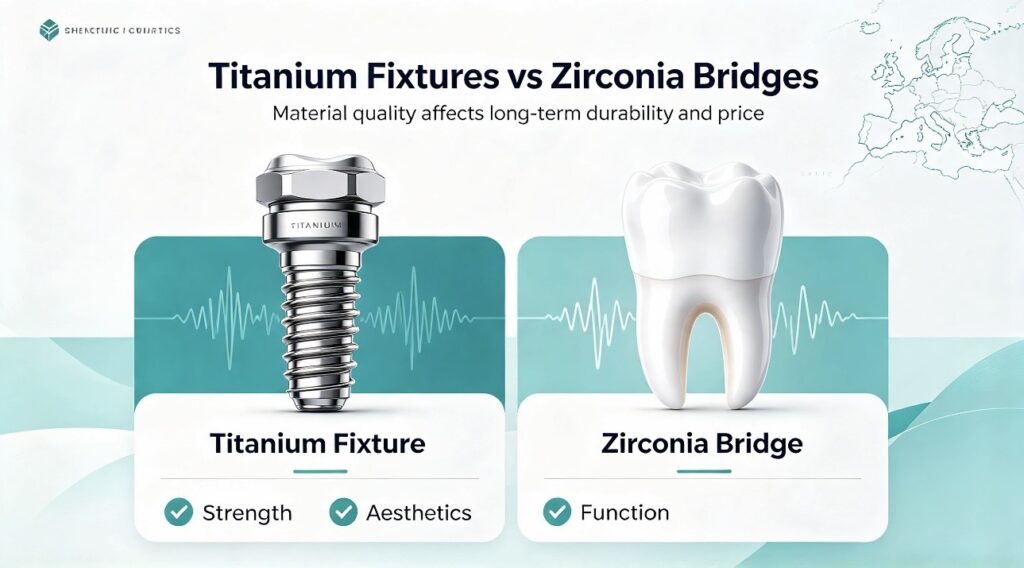
Four genuine Grade 4 commercially pure titanium or titanium-zirconium implants account for €1,400 to €2,800 of a Western European treatment quote. Tilted posterior implants require specialised 17-degree or 30-degree multi-unit abutments (€180 to €320 each) to correct angulation and create a passive screw-retained prosthetic platform.
Clinics offering “all-inclusive” packages below €5,500 frequently substitute third-party compatible abutments rather than original equipment manufacturer (OEM) components. Non-OEM screw connections carry higher micro-gap tolerances, which can void manufacturer guarantees and accelerate peri-implantitis.
Provisional PMMA vs. Final Monolithic Zirconia Bridges
Immediately following implant placement, the laboratory fabricates a screw-retained polymethyl methacrylate (PMMA) provisional bridge costing €650 to €1,200. Patients wear this acrylic arch for 12 to 24 weeks while osseointegration stabilises the four implants under controlled occlusal load.
Once soft-tissue healing completes, the clinic captures digital intraoral scans to mill the definitive bridge. A CAD/CAM monolithic zirconia arch with custom gingival porcelain layering adds €2,400 to €4,500 in laboratory fees, compared to €1,300 to €2,200 for a titanium-reinforced acrylic hybrid.
Hidden Surgical and Diagnostic Fees Excluded from Base Quotes
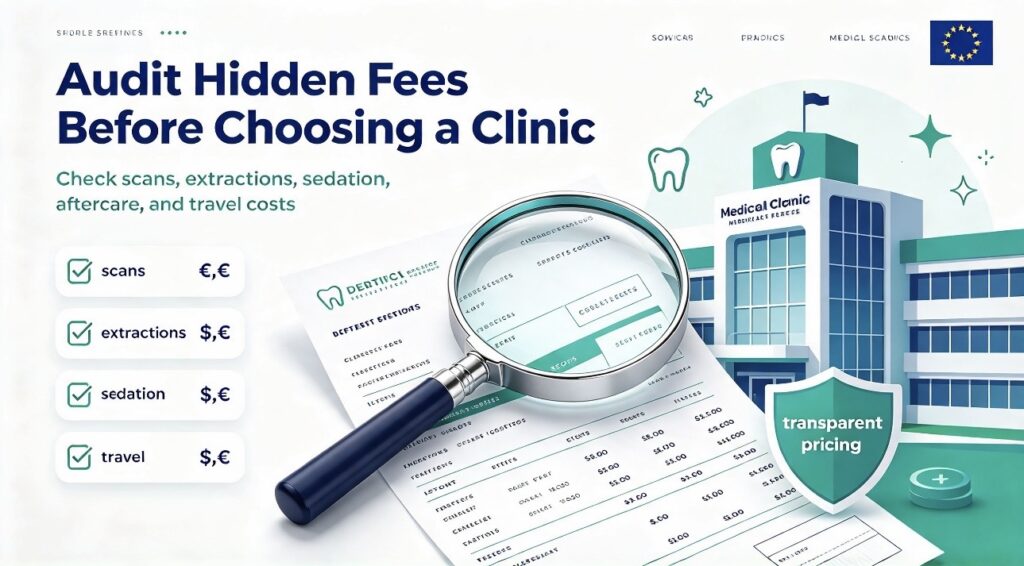
Headline prices advertised by European dental chains often cover only the four implants and a basic acrylic bridge. Patients frequently encounter €1,200 to €3,800 in mandatory ancillary charges once clinical diagnostics conclude.
- CBCT 3D Tomography and Guided Stents: Pre-operative cone-beam computed tomography scans cost €150 to €350, while custom 3D-printed surgical drill guides add €450 to €850 to improve angulation accuracy.
- Hopeless Tooth Extractions and Alveoloplasty: Removing failing dentition and levelling sharp alveolar bone ridges prior to implant placement adds €80 to €180 per tooth or €600 to €1,100 per arch.
- Intravenous Conscious Sedation: Local anaesthesia is included in base tariffs, whereas board-certified anaesthesiologist monitoring for IV sedation costs €450 to €900 per surgical session.
- Sinus Lift or Ridge Augmentation: Severe posterior maxillary atrophy occasionally requires xenograft bone particulate and resorbable collagen membranes, adding €700 to €1,900 per quadrant.
- Zygomatic or Pterygoid Rescue Implants: When conventional tilted posterior implants lack primary torque stability above 35 Ncm, longer zygomatic fixtures add €1,500 to €2,600 per implant.
How Implant Manufacturers and Cross-Border Clinics Affect Total Spend
Hardware selection represents the single largest clinical variable inside a fixed-arch treatment plan. Choosing between Swiss and Swedish flagship systems versus mid-tier European alternatives alters total expenditure by €1,200 to €2,500 per arch, as detailed in our Straumann and Nobel Biocare fixture pricing audit.
Geographic arbitrage remains the primary mechanism for reducing overall surgical bills without downgrading implant hardware. Patients travelling from London, Munich, or Stockholm routinely achieve 45% to 55% net savings on identical Swiss fixtures by comparing cross-border dental implant pricing in Hungary versus Western Europe.
Evaluation and Pricing Methodology
All 2026 pricing figures were compiled from published fee schedules and anonymised treatment plans across 48 private implant clinics in the UK, Germany, Switzerland, the Netherlands, Sweden, Spain, and Hungary. Quotes were standardised to include four CE-marked implants, four OEM multi-unit abutments, one immediate-load provisional bridge, and one definitive 12-unit prosthesis.
Regulatory benchmarks reflect compliance with EU Medical Device Regulation (MDR) 2017/745, ISO 13485 quality management for dental laboratories, and patient reimbursement rights under EU Cross-Border Healthcare Directive 2011/24/EU. All currency conversions from GBP, CHF, SEK, and HUF were calculated at Q4 2026 European Central Bank reference rates.
Frequently Asked Questions
Does a €6,000 All-on-4 quote in Europe include the final zirconia bridge?
No, base quotes near €6,000 almost exclusively cover the four implants and a reinforced acrylic-titanium hybrid bridge. Upgrading from an acrylic hybrid to a milled monolithic zirconia final prosthesis typically adds €1,400 to €2,600 across Central and Southern European clinics due to higher CAD/CAM milling and ceramic glazing costs.
Can European statutory health insurance reimburse private All-on-4 implants?
Yes, partial reimbursement applies in specific countries such as Germany under the statutory Festzuschuss fixed-subsidy system or via EU Directive 2011/24/EU cross-border rules. However, public funds generally reimburse only the equivalent cost of a standard removable denture (€500 to €1,400 per arch), leaving patients to cover the remaining private surgical balance.
How many visits to Europe are required to complete All-on-4 treatment?
Two distinct clinical visits spaced three to six months apart are mandatory for safe osseointegration. Visit one lasts four to six working days for extractions, implant surgery, and fitting the immediate-load provisional bridge, while visit two requires five to seven days for digital impressions and final bridge delivery.
What happens if one of the four implants fails during the healing phase?
Reputable European clinics replace a failed implant free of charge under a written osseointegration warranty, provided the patient attended scheduled hygiene reviews and avoided smoking. If failure occurs before final bridge fabrication, the surgeon places a replacement fixture at an adjacent site without charging additional surgical fees.
Educational Disclaimer: The clinical fee ranges and surgical protocols outlined above are provided for informational comparison only and do not constitute dental or medical advice. Individual suitability for immediate-load full-arch implants requires an in-person CBCT scan and clinical assessment by a registered oral surgeon.